From the earliest experiments with light-sensitive chemicals to sophisticated digital imaging systems, photography has evolved through countless innovations in optical engineering, chemical processes, and electronic technology.
A working chronology — not every year that mattered, but the years that changed what a photograph could be.
Chinese philosopher Mozi records earliest understanding of camera obscura principles. Aristotle provides mathematical analysis around 330 BCE.
Johann Heinrich Schulze proves silver salts darken by light exposure, establishing the photochemical foundation for all photography.
Nicephore Niepce creates "View from the Window at Le Gras," the earliest surviving photograph from nature, requiring 8+ hours exposure.
Louis Daguerre publicly introduces the daguerreotype process, producing highly detailed permanent photographs on silver-plated copper.
William Henry Fox Talbot patents the calotype, establishing the negative-positive process that would dominate photography for 150 years.
James Clerk Maxwell and Thomas Sutton demonstrate color photography using the three-color method still fundamental to color imaging today.
Photographers manipulate images to establish photography as fine art. The Photo-Secession founded by Stieglitz and Steichen in 1902.
George Eastman introduces the Kodak Number 1 box camera with "You press the button, we do the rest," making photography accessible to amateurs.
Jacob Riis publishes "How the Other Half Lives," using photography for social reform and establishing documentary photography as a tool for change.
The Leica camera brings 35mm format to still photography, establishing the compact system that would dominate professional photography for the next 70 years.
Ansel Adams, Edward Weston, and others form Group f/64, advocating "straight photography" with maximum sharpness and clarity.
Kodachrome multi-layered color reversal film introduced, setting new standards for color photography quality and stability for decades to come.
Robert Capa co-founds Magnum Photos cooperative, establishing a model for photographer-owned agencies that remains influential to this day.
Henri Cartier-Bresson publishes "The Decisive Moment," one of the most influential photography texts ever published — and a manifesto for street photography.
Steven Sasson at Kodak invents the first digital camera prototype, capturing 0.01 megapixel images onto digital cassette tape — the future, hidden inside a lab.
The Kodak DCS-100 becomes the first commercially available digital SLR camera, combining a Nikon F3 body with digital sensor technology.
The J-SH04 becomes the first commercially available camera phone, beginning the transformation of photography into ubiquitous daily practice.
AI-powered tools reshape professional workflows: automated culling, smart editing, and computational photography become standard practice across the industry.
Four photographers whose choices about what to point the camera at, and how, defined the practice for everyone who came after.
Championed photography as art, founded Photo-Secession and Camera Work journal — the magazine that argued, in print, that photographs could be art.
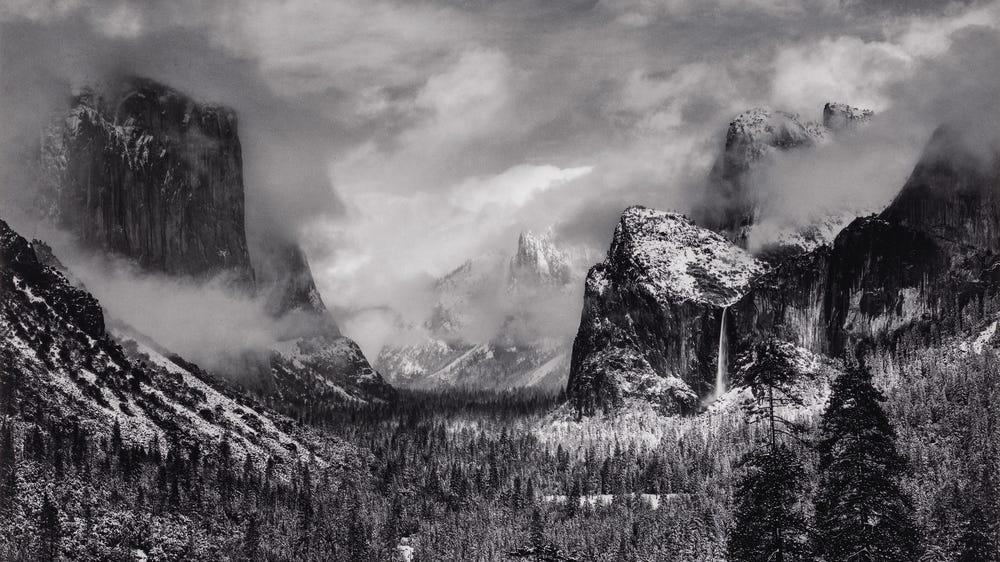
Pioneer of nature photography, developed the Zone System for exposure control. Brought the American West into the world's imagination, in monochrome.
Defined "the decisive moment," co-founded Magnum Photos. Made the small camera into a serious instrument, and the street into a serious subject.
Conceptual photographer exploring identity, gender, and media representation. The subject and the photographer are often the same person — and that is the work.
Photographers manipulated images to express creativity, tell stories, and create dream-like imagery that elevated the medium above mere documentation.
The Photo-Secession, founded by Alfred Stieglitz and Edward Steichen in 1902, aimed to compel recognition of photography as a distinct medium of individual artistic expression. Camera Work journal featured high-quality photogravure images establishing Pictorialist aesthetics as serious art.

A direct reaction against Pictorialism, advocating for photography that embraced the medium's mechanical characteristics rather than imitating painting.
Founded by Ansel Adams, Edward Weston, Imogen Cunningham, and others in San Francisco. Named after the smallest aperture setting, symbolizing commitment to maximum depth of field and overall sharpness. Their principles became foundational to much subsequent photographic practice.
From Jacob Riis's documentation of New York slums that spurred reform legislation to photojournalistic images that shaped public understanding of conflicts, photography's apparent objectivity has been leveraged for advocacy, propaganda, and documentation across the modern era.
As photography enters its third century, fundamental principles established by early pioneers remain relevant even as technologies continue to transform practice — suggesting that photography's essential appeal will continue driving innovation into an uncertain but promising future.